General Outline
Part 2 last for 3-4 minutes and begins when the examiner starts with the scripted wording, “Now I am going to give you a topic….”.
The candidate needs to speak with little or no hesitation with no help from the examiner – for at least 1 minute and up to 2 minutes about the topic on the card you are given/shown. Despite the temptation or what you may have been told, the candidate cannot/should not change this topic and/or talk about any other topic. Your final mark for lexical resource will be lower if you do. You need to give an organised answer by following the instructions/prompts written on the card.
If you have finished before 2 minutes, tell the examiner. Don’t keep talking just to fill up time. If the examiner ends your turn after 2 minutes, don’t apologise, you’ve done nothing wrong.
The examiner may/may not ask the candidate a follow-up question(s) at the conclusion of the presentation.
1 Minute Preparation/Task Card
When the examiner hands you/shows you the card, your one minute preparation time has begun. Read the card carefully, noting what the topic is. Since there is no title on the card, the topic might not be immediately clear, but the topic is given in the very first sentence. It is divided into 2 parts. In the example below, “something you own” and “very important to you” are the topic.
Both need to be combined into a single presentation about the topic as well as all relevant information listed with instruction words: “describe, should say, where you, how long you, what you use, explain why”. All should be included in your answer if possible. If you add extra information, make sure it is not off topic.
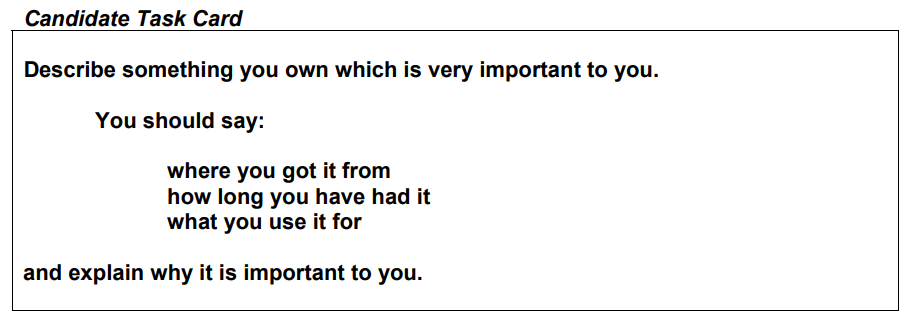
The best approach is to read the card quickly from beginning to end. Then, go back through each specific instruction after the topic sentence. Think of things to say about each of the instructions in the remaining time you have and make notes which can be used as reference during the speech. As there are usually 3 or 4 instructions to speak about, aim to speak for 20-30 seconds on each one.
A candidate does not have to use all of the 1 minute preparation time however, the more time to prepare, the better the answer a candidate should be able to prepare. Therefore, always use your 1 minute preparation time (even if you use the time to relax and focus).
Giving The Presentation
In Part 2, the examiner is particularly interested in a candidate’s coherence. Coherence means that you must follow a logical and clear progression about the topic on the task card as you speak. In Part 1, this is only tested in short question/answer responses. Now, the candidate must speak on their own for up to 2 minutes. Of course, the candidate also need to be as fluent as possible and speak without any unnatural or forced pauses. Grammar/pronunciation are also expected to improve and develop further from Part 1.
Don’t worry if some of what you have to say is “made up”. You’re not been tested on the factual content of what you say, but more on how you say it in English. Don’t try to learn set phrases as this will just sound false. But, do learn words and phrases that will prompt and guide you. However, again, keep in mind that any long memorised answers you give have already been given by thousands of other candidates. If the examiner is looking bored while you talk, it is probably because he/she has already heard your presentation anywhere between 10-20 times in the past week. Keep to the point, and make sure what you say is relevant and authentic. Remember, memorised answers that replace a candidate’s authentic language, will lower a candidate’s final lexical resource score.
A way to “break up” memorised/set phrases so they are less obvious is to use vocabulary that is directly related to the topic. A good method is to ask yourself the following question: “Can this word be used for many other topics?”
If the answer is “Yes” then that word is NOT directly related to the topic. Look at the following example:
Topic: Describe some travelling you would like to do in a different country from your own.
Now look at the vocabulary below. Which words are directly related to the topic?
- exciting
- sightseeing
- overseas
- interesting
- attractive
- leave
- opportunity
- special
- tourist
- explore
- mountain
An examiner would probably pick out (2), (3), (7), (9), (10). Each of these have direct correlation to either/both parts of the topic.
- sightseeing = travelling/looking at different famous places
- overseas = going to another country
- opportunity = chance to do something different/try new things
- tourist = a person spending time away from home for recreation, relaxation, and pleasure
- explore = visit new places or have new experiences
Follow-Up Questions
The examiner may ask the candidate one or two questions at the end of their presentation. These questions will always be related to the topic on the task card. You should only give short answers because there may not be much time is left. Also, if the information in the question was covered during the candidate’s speech and/or if the candidate’s speech was off-topic, the examiner does not have to ask any questions.
For the task card shown above, examples might be:
- Is this thing still important to you?
- Do other people know how important it is to you?
Short, accurate, on topic answers which either extend or re-enforce information provided in the presentation, help to establish the candidate’s credibility for Part 3.